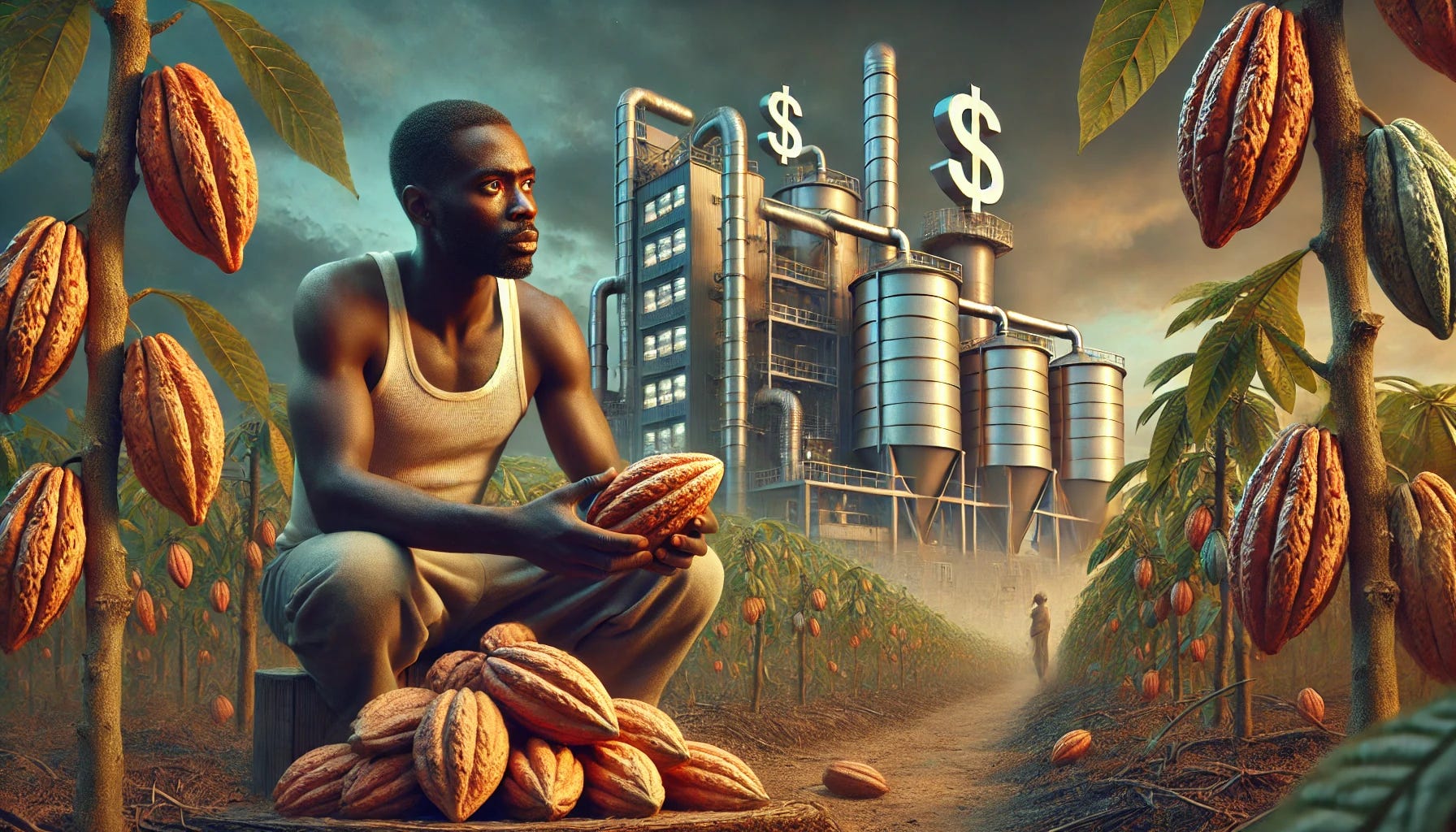
Let’s revisit Ghana Freezones as a Policy that had intentions whose unintended consequences overshadowed it in the Ghanaian cocoa-chocolate value chain.
The introduction of Ghana’s Free Zones policy in the mid-1990s was a strategic attempt to accelerate export-driven industrialisation, attract foreign direct investment (FDI), and enhance value addition in key export sectors, including cocoa. Designed with generous incentives such as tax holidays, duty exemptions, and unrestricted capital repatriation, the policy aimed to position Ghana as a competitive global processing hub. From a political perspective, however, the outcomes of this policy have been shaped by the interests, power asymmetries, and interactions among key actors, that is the state, multinational corporations (MNCs), local cocoa farmers, and indigenous processors. This article will explore how these interests aligned or conflicted, resulting in both intended and unintended consequences with significant implications for Ghana’s cocoa sector which leaves the farmer to shoulder all the negatives of it.
Ghana’s cocoa sector has long been central to its economy, contributing approximately 25% of foreign exchange earnings, with over 800,000 smallholder farmers as the backbone. Recognising this strategic importance, policymakers viewed the Free Zones policy as a mechanism to increase domestic processing capacity and enhance export revenues through value-added cocoa products. However, from a political perspective, the state’s interest in maintaining fiscal stability and securing external advantages from multinational companies often conflicted with the welfare of local actors, particularly smallholder farmers and Indigenous processors.
Multinational corporations such as Barry Callebaut, Cargill, and Olam leveraged the Free Zones policy to establish cocoa processing plants in Ghana. These corporations were attracted by the proximity to raw materials, reducing logistical costs and ensuring a reliable supply chain. However, the operations of these firms reveal a crucial flaw in the policy: while cocoa processing physically occurs in Ghana, the financial benefits largely accrue outside the country. These MNCs operate as subsidiaries of global conglomerates, with sales, marketing, and financial transactions managed by headquarters abroad.
Consequently, although production figures are recorded locally, foreign exchange earnings remain offshore, undermining one of the policy’s primary objectives, i.e. to increase our foreign exchange. I officially asked the Ghana Free Zones Board to confirm how they assess our reception of foreign exchange from these firms in Ghana. They confirmed that foreign exchange earnings are measured based on production value rather than actual cash inflows into local banks, further complicating efforts to track economic benefits.
A critical aspect of this article is understanding how power relations influence the distribution of benefits within the value chain. In this case, the Free Zones policy has disproportionately favoured Multinational Corporations, who wield significant bargaining power due to their control over global cocoa markets. These corporations extract undue benefits by capitalising on tax incentives and low production costs (due to low labour, proximity to supply, reduced shipping costs due to low volume and high value expect, etc) without contributing commensurately to the local economy. For example, despite benefiting from subsidised utilities and infrastructure, most MNCs retain profits abroad (because the policy allows them the opportunity to do so) hence limiting Ghana’s foreign exchange gains and the circulation of such turnovers in the country to to boost the economy.
Employment creation, a key policy justification, has also been underwhelming. While initial projections anticipated significant job growth, many processing plants are highly automated (Known of cocoa processing factories), requiring minimal human labour. Without stringent labour regulations mandating local employment quotas in both senior and middle-level management, firms will rightfully prioritise capital-intensive operations to maximise profits. This approach aligns with the broader profit-driven motives of MNCs but contradicts Ghana’s development goals of employment generation and poverty reduction through the freezone policy. Moreover, Ghana’s ambition to become a digital hub in Africa creates policy tension: enforcing labour-intensive practices may conflict with technological advancement agendas, leaving policymakers in a bind.
Ghanaian taxpayers, including cocoa farmers, largely financed the infrastructure required to support Free Zones companies such as roads, electricity, water, and port facilities. This creates a financing paradox: local stakeholders, particularly smallholder farmers, indirectly subsidise foreign investors through taxes yet derive limited direct benefits. The state’s prioritisation of infrastructure development for Free Zones companies has often come at the expense of rural communities, where inadequate infrastructure continues to hinder productivity.
More
over, local processors serving the domestic market ( which is non-existent) are excluded from these incentives, making it difficult for them to compete with foreign firms. This is why we don’t have any processing companies producing for local chocolatiers. A Ghana Chamber of Commerce report highlighted this inequity, noting that indigenous processors face higher production costs and regulatory burdens (including paying all the taxes that their foreign counterparts do not), which constrain their growth potential. How do we protect local Cocoa grinders who want to process for local chocolatiers, by making their products more expensive than their foreign competitors’ producing locally in Ghana for foreign consumption? This dynamic shows how the unintended consequences of the freezone policy perpetuate structural inequalities by privileging powerful external actors over local stakeholders.
Also the Free Zones policy is to demonstrate Ghana’s strategy to secure external benefits and showcase Ghana as a favourable investment destination. However, this approach has also created opportunities for benefit-seeking behaviour among political elites. The allocation of Free Zones licenses and incentives is often influenced by political connections, with well-connected firms enjoying preferential treatment. This has led to a situation where the policy’s benefits are captured by a narrow group of actors, which undermines its broader developmental objectives of increasing foreign exchange (for Ghana), Job creation, improved livelihoods, etc.
Further to this is the lack of transparency in monitoring and evaluating the policy’s outcomes, which has limited accountability. While official reports highlight increases in production capacity and export volumes, they often omit critical metrics such as net foreign exchange inflows, local employment figures, and the economic welfare of cocoa-growing communities. Without comprehensive data, it is difficult to assess the policy’s true impact or implement necessary reforms. For example, do we measure increased turnover from each factory with an expected increase in labour to help fulfil the employment requirement of the policy? Should we measure the foreign exchange expectations by ensuring that sales of the products produced in Ghana stay for a while in the factory’s Ghana bank account to ensure that the benefits of having an inflow of foreign exchange are realised?
The Ghana Free Zones policy, maybe well-intentioned, but the role of state interests, multinational power, and local stakeholder disenfranchisement has produced mixed outcomes, with significant unintended consequences. Addressing these issues requires a recalibration of the policy to ensure more equitable benefits distribution, greater local participation, and enhanced transparency. Being attentive to monitoring and evaluation of outcomes that require measuring intended expectations from policy beneficiaries against the actual deliverables of the free zones to ensure the cocoa farmers do not keep financing stakeholders within the value chain who consistently undermine their ability to capture value from the cocoa-chocolate value chain.
Let me know your perspective
Comments 0
No comments yet. Be the first to share your thoughts.